Do All Repair Attempts Have to Be for the Same Problem to Qualify Under California Lemon Law
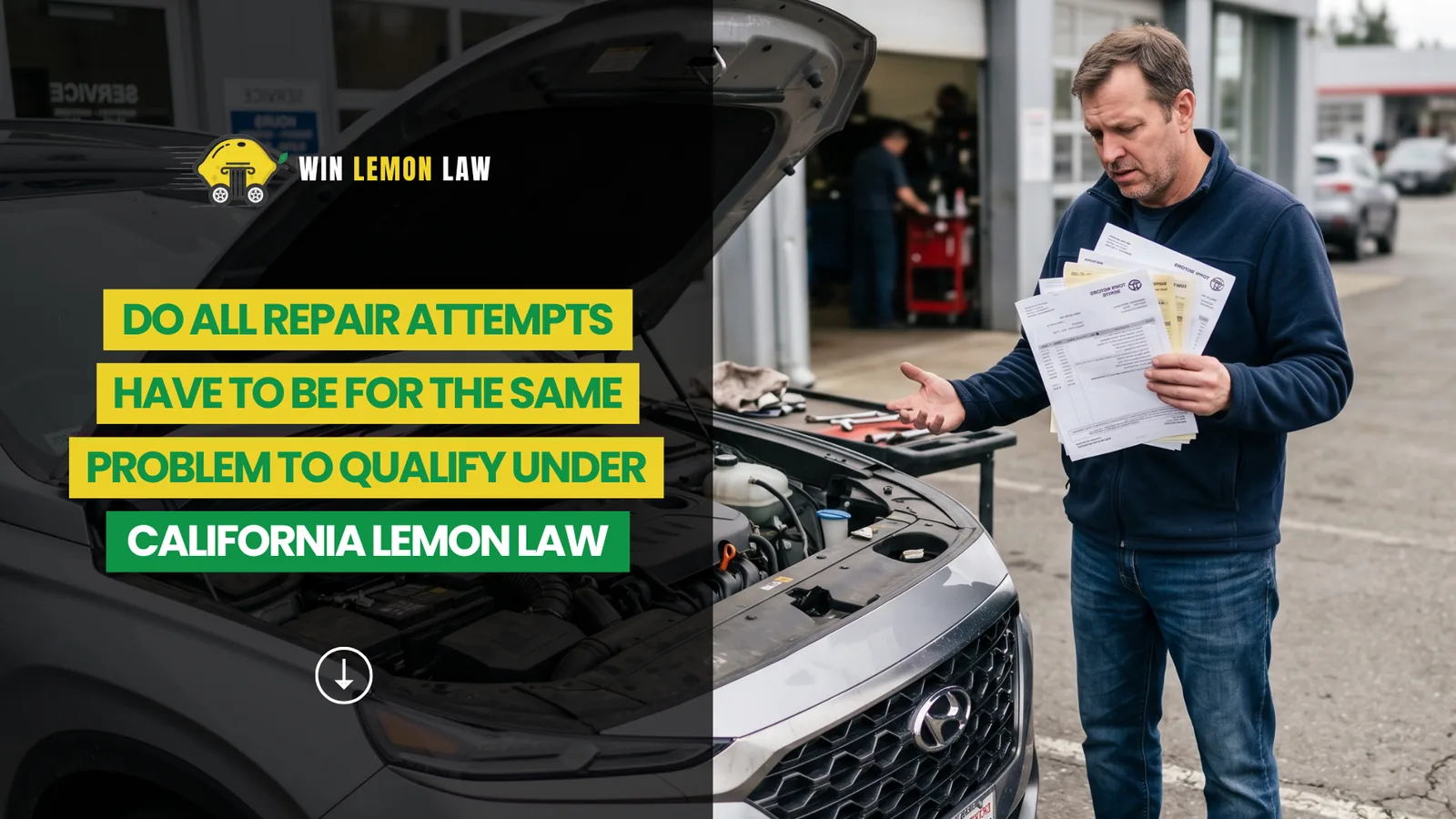
Many vehicle owners believe that in order to qualify under California Lemon Law, they must take their vehicle to the dealership multiple times for the exact same issue. This belief often causes confusion, especially when a vehicle experiences different problems over time.
In reality, California Lemon Law does not require every repair attempt to involve the same defect. While repeated attempts to fix a single issue can clearly support a claim, the law also recognizes that some vehicles develop multiple problems that together show the vehicle is not reliable.
Understanding how repair attempts are evaluated can help drivers determine whether their situation may qualify, even if the issues they are experiencing are not identical.
Where the “Same Problem” Misconception Comes From
The idea that the same issue must be repaired multiple times comes from simplified explanations of Lemon Law. Many examples focus on a single recurring defect, such as a transmission failure or engine issue.
While those examples are helpful, they do not represent every situation. The law is broader and considers whether the vehicle as a whole is defective.
This means that focusing only on whether the same problem repeats can cause drivers to overlook valid claims involving multiple issues.
How California Lemon Law Actually Evaluates Repair Attempts

California Lemon Law looks at whether the manufacturer has been given a reasonable number of opportunities to repair the vehicle. This evaluation considers the total repair history, not just a single issue.
Repair attempts may involve the same defect, different defects, or a combination of both. What matters is whether the problems substantially affect the vehicle’s use, value, or safety.
The law is designed to protect consumers from vehicles that cannot be made reliable, regardless of whether the problems are identical.
When Repeated Repairs for One Issue Strengthen a Claim
If a vehicle is brought in multiple times for the same issue and the problem continues, it creates a clear pattern. This shows that the manufacturer has not been able to fix the defect.
For example, repeated transmission hesitation or ongoing engine misfires can demonstrate that the issue remains unresolved.
This type of case is often straightforward because the pattern is easy to identify.
When Multiple Different Problems Still Indicate a Defect
Many vehicles do not have just one issue. Instead, they may develop a series of different problems affecting various systems.
A vehicle may experience electrical failures, warning lights, performance issues, and mechanical concerns at different times. While each issue may seem separate, together they can show that the vehicle is not functioning properly.
When these problems continue despite repair attempts, they may collectively meet the standard for a Lemon Law claim.
How the Overall Pattern of Repairs Becomes the Key Factor
Instead of looking at each repair attempt individually, Lemon Law focuses on the overall pattern. A vehicle that repeatedly requires service may indicate a deeper issue.
For example, a vehicle that is brought in multiple times for different concerns still shows a pattern of unreliability.
This pattern can be just as important as repeated repairs for a single issue.
Why Modern Vehicles Often Have Multiple Related Issues
Modern vehicles rely on complex systems that interact with each other. Engine performance, transmission behavior, electrical systems, and safety features are all connected.
Because of this, a problem in one area can lead to issues in another. For example, an electrical fault may affect engine performance or safety systems.
This interconnected design means that multiple issues may actually stem from a common underlying problem.
When Different Problems Share a Common Cause
In some cases, what appears to be separate issues may actually be related. For example, a software or sensor problem may cause warning lights, performance issues, and system malfunctions.
Even though these problems appear different, they may originate from the same source.
Recognizing this connection can help demonstrate that the vehicle has a broader defect rather than isolated issues.
How Dealerships Handle Multiple Complaints
Dealerships often address issues one at a time. Each visit may focus on a specific complaint, and the repair may be limited to that issue.
This approach can make it seem like each problem is unrelated. However, when viewed together, the repair history may reveal a consistent pattern of issues.
Understanding how these records are created helps explain why multiple issues can still support a claim.
The Role of Severity in Evaluating Different Issues
Not all problems carry the same weight. Some defects are more serious than others, especially those affecting safety.
For example, a braking issue or steering problem may be considered significant even if it occurs only a few times. Less severe issues may require more repair attempts to meet the standard.
When multiple issues are present, their combined severity can play an important role in determining whether the vehicle qualifies.
When Multiple Smaller Issues Create a Larger Problem
A vehicle does not need a single major failure to be considered defective. Multiple smaller issues can add up over time and create a significant impact.
For example, a combination of hesitation, warning lights, and electrical glitches can make the vehicle unreliable.
Even if each issue seems minor on its own, the overall effect can interfere with normal use and reduce confidence in the vehicle.
Why Manufacturers May Focus on Individual Repairs
Manufacturers and dealerships often approach problems individually. Each repair attempt may be treated as a separate issue rather than part of a larger pattern.
This approach can make it seem like the vehicle does not have a major defect. However, it does not address the overall reliability of the vehicle.
Lemon Law takes a broader view, considering how all the issues affect the vehicle as a whole.
The Impact on Daily Driving and Reliability
When a vehicle experiences multiple problems, it can affect daily driving in different ways. Drivers may encounter hesitation, warning lights, or system malfunctions at various times.
This inconsistency can make the vehicle feel unreliable. Drivers may not know what issue will occur next or how the vehicle will respond.
Over time, this unpredictability can reduce confidence and satisfaction with the vehicle.
How Multiple Issues Affect Vehicle Value
A vehicle with a history of multiple problems may be less attractive to buyers. Even if repairs have been attempted, the record of issues can raise concerns about long term reliability.
This can reduce resale value and make it harder to sell the vehicle.
California Lemon Law considers whether defects substantially impair a vehicle’s value as well as its use and safety.
When a Vehicle Qualifies Without Identical Repair Attempts
A vehicle may qualify under Lemon Law even if the repair attempts involve different issues. The key is whether the vehicle continues to experience defects despite those attempts.
If the problems collectively show that the vehicle is unreliable, it may meet the legal standard.
This is especially true when the issues affect important aspects of performance or safety.
Why These Cases Are More Common With Newer Vehicles
As vehicles become more advanced, they rely on integrated systems that can create multiple issues when something goes wrong.
Electrical systems, sensors, and software all play a role in vehicle performance. When one part of the system fails, it can affect other areas.
This makes it more likely for vehicles to experience multiple related problems rather than a single isolated defect.
How Win Lemon Law Evaluates Complex Repair Histories
At Win Lemon Law, we understand that not all cases involve a single repeated issue. Many vehicles have a history of different problems that together indicate a larger defect.
We review the full repair history to identify patterns and evaluate how the issues affect the vehicle’s use, value, and safety.
Our goal is to determine whether the vehicle meets the requirements under California Lemon Law based on its overall performance, not just individual repairs.
If the case qualifies, potential outcomes may include a vehicle buyback, replacement vehicle, or financial compensation.
California Lemon Law generally requires manufacturers to pay attorney fees and costs in successful cases, allowing consumers to pursue their claims without additional financial burden.
Contact Win Lemon Law for Help With Multiple Vehicle Issues
If your vehicle has experienced multiple problems that do not stay fixed, you may still have rights under California Lemon Law.
You should not assume that your claim is invalid simply because the issues are not identical.
The experienced California Lemon Law attorneys at Win Lemon Law can review your repair history, explain your options clearly, and help determine whether your vehicle qualifies for relief.
Contact Win Lemon Law today for a free case evaluation.
Think you have a lemon?
Get a free case review — we only get paid if you win.
Related articles
Honda Transmission and Fuel Injector Problems in Newer Models
Honda vehicles have long been known for reliability, efficiency, and consistent performance. Many drivers choose Honda expecting a vehicle that
Read more May 5, 2026Can a Lemon Law Claim Be Filed After the Warranty Has Expired in California
Many vehicle owners believe that once a manufacturer’s warranty expires, their legal options disappear as well. This assumption often prevents
Read more April 30, 2026Subaru CVT Transmission Hesitation and Reliability Issues in Newer Models
Subaru vehicles are known for their all wheel drive capability, practicality, and reputation for reliability. Many drivers choose Subaru…
Read more