Can You File a Lemon Law Claim Without Warning Lights or Error Codes in California
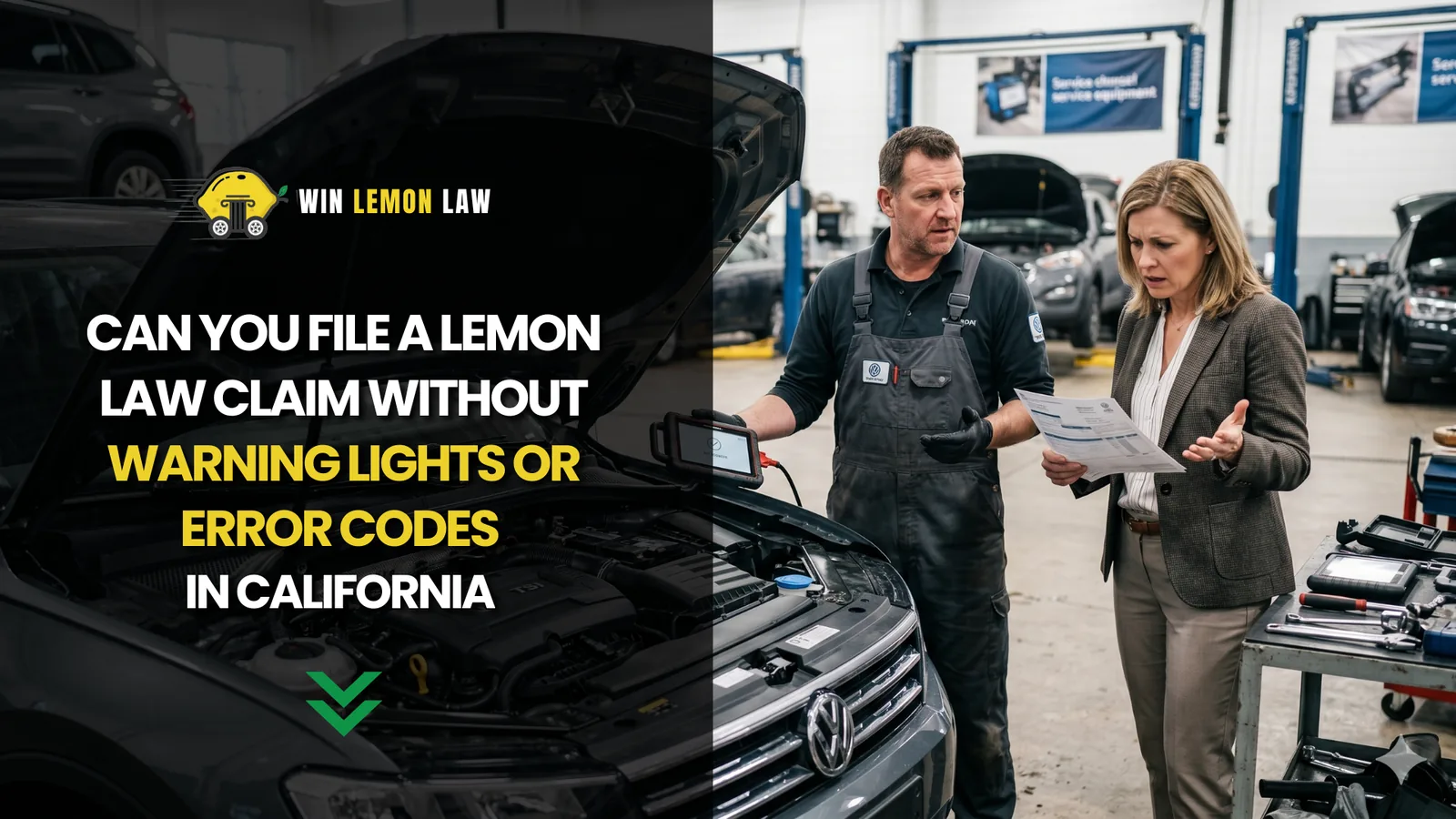
Many vehicle owners assume that if their car does not display a warning light or generate an error code, there is no real problem. This belief is rooted in how modern vehicles are designed. Dashboard alerts and onboard diagnostic systems are intended to notify drivers when something goes wrong.
However, not all defects trigger warning lights or fault codes. Some of the most frustrating vehicle problems occur without any visible alerts, leaving drivers with a car that does not perform correctly but cannot easily be diagnosed.
This situation often leads to confusion. Drivers may feel something is wrong, but without electronic confirmation, they are told the vehicle is functioning normally. This raises an important question under California Lemon Law. If your vehicle has ongoing issues but no warning lights or error codes, can it still qualify?
The answer may be yes. California Lemon Law does not require a warning light or diagnostic code to prove that a defect exists. What matters is whether the vehicle has a substantial issue that affects its use, value, or safety and whether the manufacturer has had a reasonable opportunity to repair it.
Understanding how these cases are evaluated is critical for drivers who feel stuck with a vehicle that does not perform as expected but lacks clear diagnostic proof.
Why Warning Lights Are Not the Final Authority
Modern vehicles rely on onboard diagnostic systems to monitor performance. These systems track specific components and trigger alerts when predefined thresholds are exceeded.
While these systems are helpful, they are not designed to detect every possible issue. They operate based on programmed parameters. If a problem does not fall outside those parameters, it may not trigger any alert.
For example, a component may function poorly but still remain within the acceptable range set by the system. In this case, the vehicle may perform inconsistently without generating a warning light.
This limitation is important. It means that the absence of a warning light does not guarantee that the vehicle is functioning properly.
The Types of Issues That Often Go Undetected
Many common vehicle problems do not consistently trigger error codes. These issues are often related to performance, drivability, or intermittent system behavior.
Drivers frequently report hesitation when accelerating, delayed response from the engine, uneven shifting, or vibrations during normal driving. These symptoms may not be severe enough at any given moment to trigger a fault code, but they can still affect the overall driving experience.
Electrical issues are another common example. A system may briefly fail and then reset itself, leaving no trace in the diagnostic system. Infotainment glitches, temporary sensor malfunctions, or inconsistent safety system behavior may all fall into this category.
Because these problems are not constant, they are less likely to be captured by onboard diagnostics.
Why Intermittent Problems Are Hard to Capture
Intermittent problems are among the most difficult to diagnose. They occur under specific conditions and may not appear during a dealership inspection.
For example, a vehicle may hesitate only after extended driving, during cold starts, or in heavy traffic. If those conditions are not present during testing, the issue may not occur.
Diagnostic systems rely on consistency. If a problem does not happen often enough or long enough, it may not be recorded.
This creates a situation where the driver experiences real problems, but the system does not provide any confirmation.
The Disconnect Between Driver Experience and Diagnostics
One of the most frustrating aspects of these cases is the disconnect between what the driver experiences and what the dealership can verify.
Drivers rely on how the vehicle feels and behaves during everyday use. They notice patterns, inconsistencies, and changes in performance.
Dealerships rely on diagnostic tools and observable faults. If those tools do not detect a problem, they may conclude that no issue exists.
This disconnect can lead to repeated visits where no repairs are performed, even though the problem continues.
When Dealerships Say the Vehicle Is Operating Normally

Without warning lights or error codes, dealerships may determine that the vehicle is operating as designed. This response can leave drivers without a clear path forward.
However, this conclusion does not necessarily reflect the full reality of the situation. A vehicle can behave inconsistently or unreliably without triggering diagnostic alerts.
Repeated visits with the same complaint are important. They create a record that shows the issue persists, even if it cannot be confirmed electronically.
Why Repeated Complaints Matter More Than Error Codes
California Lemon Law focuses on the pattern of the problem, not just the presence of a diagnostic code. Repeated complaints and repair attempts demonstrate that the issue has not been resolved.
Each visit to the dealership adds to the history of the problem. Over time, this history can show that the vehicle has a persistent defect.
The law does not require that the defect be proven through electronic data alone. Driver reports and repair records play a critical role.
How Performance Based Defects Are Evaluated
Performance based defects are evaluated based on how they affect the vehicle’s use, value, or safety. These issues are often subjective, but they can still have a significant impact.
For example, hesitation during acceleration may affect the driver’s ability to merge safely. Inconsistent braking responses may create uncertainty in everyday driving.
These issues may not produce error codes, but they can still meet the standard for a Lemon Law claim if they persist and affect normal use.
The Role of Repair Opportunities
A key element of any Lemon Law claim is whether the manufacturer has had a reasonable opportunity to repair the defect.
Even if no error codes are present, repeated visits for the same issue demonstrate that the manufacturer has been given that opportunity.
If the problem continues despite those attempts, it may indicate that the vehicle cannot be properly repaired.
Why Modern Vehicles Are More Prone to These Cases
Modern vehicles rely heavily on software, sensors, and integrated systems. While this improves performance and efficiency, it also creates new challenges.
Systems may behave unpredictably or fail in ways that are not easily detected. Communication errors between components may not trigger fault codes but can still affect performance.
As a result, more drivers are experiencing real issues that are not captured by diagnostic systems.
The Impact on Reliability and Confidence
Driving a vehicle with unresolved issues can affect confidence and reliability. Drivers may feel uncertain about how the vehicle will perform in certain situations.
This uncertainty can lead to stress and frustration. Even if the vehicle remains drivable, the lack of consistent performance can affect daily use.
These factors are considered when evaluating whether a vehicle meets the standard under California Lemon Law.
When These Issues May Qualify Under California Lemon Law
A vehicle may qualify if it has a defect that substantially impairs its use, value, or safety and cannot be repaired after a reasonable number of attempts.
This standard does not require warning lights or diagnostic codes. It focuses on the real world impact of the defect.
If the problem continues and affects how the vehicle is used or valued, it may meet the legal requirements.
Frequently Asked Questions About Lemon Law Without Warning Lights

Can my car still be considered a lemon if no warning lights appear?
Yes. A vehicle can qualify if it has a persistent defect that affects its use, value, or safety, even without warning lights.
What if the dealership cannot find anything wrong?
Repeated visits where no issue is found can still support a claim. They show that the problem exists but has not been resolved.
Do I need an error code to prove my case?
No. Diagnostic codes are not required. The focus is on the defect and its impact.
What types of problems qualify without codes?
Issues such as hesitation, rough shifting, inconsistent braking, or intermittent electrical failures may qualify if they persist.
Can intermittent problems still count under Lemon Law?
Yes. Even if a problem does not occur all the time, it can still qualify if it affects the vehicle and continues over multiple repair attempts.
How Win Lemon Law Helps With These Cases
At Win Lemon Law, we help California drivers who are dealing with vehicles that do not stay fixed, even when no diagnostic codes are present.
We review repair histories, identify patterns of repeated complaints, and evaluate how the issue affects the vehicle’s use, value, or safety.
We understand that not all defects are captured electronically. Our approach focuses on the full context of the case, including driver experience and repair attempts.
If the case qualifies, potential outcomes may include a vehicle buyback, replacement vehicle, or financial compensation.
California Lemon Law generally requires manufacturers to pay attorney fees and costs in successful cases, allowing consumers to pursue their claims without additional financial burden.
Contact Win Lemon Law for Help With Undiagnosed Vehicle Problems
If your vehicle continues to experience problems but does not display warning lights or error codes, you may still have rights under California Lemon Law.
You should not assume that your claim is invalid simply because the issue has not been confirmed electronically.
The experienced California Lemon Law attorneys at Win Lemon Law can review your repair history, explain your options clearly, and help determine whether your vehicle qualifies for relief.
Contact Win Lemon Law today for a free case evaluation.
Think you have a lemon?
Get a free case review — we only get paid if you win.
Related articles
Volkswagen Electrical and Sensor Failures in Newer Vehicles
Volkswagen vehicles are widely recognized for their engineering, European design, and balance of performance and practicality. Many drivers…
Read more May 12, 2026Do All Repair Attempts Have to Be for the Same Problem to Qualify Under California Lemon Law
Many vehicle owners believe that in order to qualify under California Lemon Law, they must take their vehicle to the
Read more May 7, 2026Honda Transmission and Fuel Injector Problems in Newer Models
Honda vehicles have long been known for reliability, efficiency, and consistent performance. Many drivers choose Honda expecting a vehicle that
Read more